
ELMINA, Ghana. A new mural on one of Elmina’s most historic buildings is turning colonial memory into public art, part of a wider push to make this coastal town a destination for art and music alongside its centuries-old history.
The mural is the first major work under the Town of Art initiative, a project pairing visual art and music to enliven Elmina and expand the reach of the Edina Bakatue festival, the town’s annual celebration marking the opening of the fishing season. Organizers behind the initiative say the goal is twofold: draw a wider audience to Bakatue and beautify the town itself, turning walls that have stood quietly for generations into new points of interest for residents and visitors.
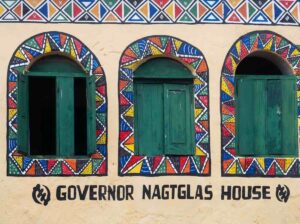
The first work chosen for that effort sits on the Cornelis Nagtglas House, a two-story building constructed in 1862 by Cornelis Johannes Marius Nagtglas, the Dutch governor of the Gold Coast, for his Ghanaian wife, Anna Abraba Smith. The house has stood for more than 160 years as a physical record of Elmina’s entangled history, built by a European colonial administrator, but for a Ghanaian family, and it remains tied to both nations’ histories today.
Emmanuel Eshun and his team of local artists in Elmina worked alongside Dutch Ghanaian artist Richard Kofi to paint the mural on the house’s exterior. The piece depicts a wave rendered in the sweeping style of Japanese woodblock prints, rising over three colonial-era ships. The ships fly the flags of the Netherlands, Portugal and Britain, the three powers that traded in and governed Elmina at different points in its history.
In the mural, the ships are not shown mastering the sea. They are shown submitting to it, pushed and overtaken by the wave. The composition is a deliberate reversal of the way that history is usually told, according to the project’s organizers, who said it counters popular narratives about the strength of European trading companies, including the Dutch East India Company, often referred to by the so-called “VOC mentality” of dominance and control.
Organizers describe the piece as an act of homage rather than confrontation: a recognition of the spiritual power of the water itself, and an assertion that nature, not any trading company or colonial power, holds ultimate authority. Water, they say, holds memory, carrying the record of what was brought to Elmina’s shores and what was taken from them.
Nana Conduah VI, the paramount chief of the Edina Traditional Council, formally received the artwork on behalf of the council and thanked Kofi and his team for their work preserving and sharing Elmina’s history through art. He also thanked the Embassy of the Kingdom of the Netherlands in Ghana, which supported the project.
The mural is expected to be the first of several works planned for Elmina under the Town of Art initiative, as organizers continue building out a program of art and music intended to complement the town’s historic sites and give Bakatue a bigger stage in the years ahead.