
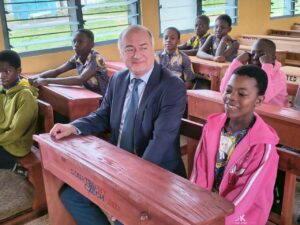
ELMINA, Ghana — A visit to a classroom where children sat on stones and bare floors set in motion a donation of about 400 dual desks to basic schools across the Komenda-Edina-Eguafo-Abrem Municipality, handed over July 8 as part of the 2026 Edina Bakatue Festival.
The desks came from the Embassy of the Czech Republic in Accra, working with the Lemon Family Foundation.
David Duron, the development chief of Elmina, who holds the stool name Nana Ekow Ankama I, said the idea took shape after he stopped at a basic school in Bantuma.
“Seeing children forced to learn while sitting on the floor and on stones brought me to tears,” Duron said. “I knew something had to be done to restore dignity to their learning environment.”
Pavel Bilek, the Czech ambassador to Ghana, presented the furniture. He said the embassy has made education a priority and that proper desks give pupils a setting in which they can concentrate and do better work.
Ghana’s Ministry of Education sets a pupil seating ratio of 2-to-1, two children to one dual desk. By 2021, about 40% of pupils nationwide fell short of it, a shortfall the education think tank Africa Education Watch puts at more than a million desks. The KEEA Municipal Education Directorate reports 36,352 children in public basic education across the municipality’s eight circuits, in 218 schools. The 400 desks seat 800 of them.
What the shortage costs is not only comfort. Children without desks write on their laps, on the floor or on their stomachs, and Africa Education Watch has recorded the resulting postures interfering with reading and writing during lessons. The group has also documented schools asking parents to buy desks for children moving from Primary 6 into junior high, a charge that discourages the move.
The think tank has estimated it would take about 330 million cedis to clear the national backlog, and roughly 18 years at the rate money has gone into basic school furniture. It attributes the gap partly to the Pre-tertiary Education Act, which made district assemblies responsible for basic school infrastructure without the revenue to pay for it.
The deficit is deepest in the north, running at 80% in North East and 70% in Northern. The Central Region is not among the regions above the national average.
Isaac Yirenkyi Yeboah, chief executive officer of the Lemon Family Foundation, said the desks went to schools throughout the municipality rather than to Elmina alone, despite the donation’s place on the festival calendar. He said the foundation remains committed to supporting education in the area and that further work on school infrastructure would follow.
Education officials, traditional leaders and head teachers at the receiving schools thanked the embassy, the foundation and their partners.